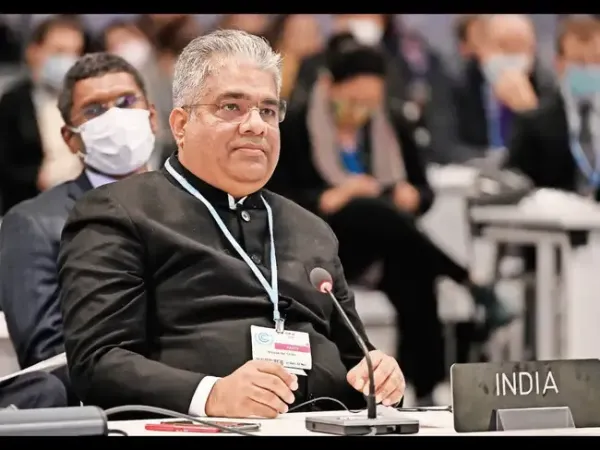
Yadav has announced initiatives at COP31 with Japan and Sweden, and held talks with counterparts from the BASIC bloc, which includes Brazil, South Africa and China. Together with Germany’s environment minister Carsten Schneider, he’s also steered consultations on the future of the mitigation work program — an initiative that’s aimed at pressing countries to cut emissions faster.
India is hard to spot in exhibition halls at the annual United Nations climate talks, but difficult to avoid in its negotiating rooms.
Unlike dozens of other nations with flashy promotional pavilions, the country has no dedicated booth at the summit in Antalya, Turkey, and an official delegation of about 152 registered attendees is smaller than those of Bangladesh, Pakistan or Nepal.
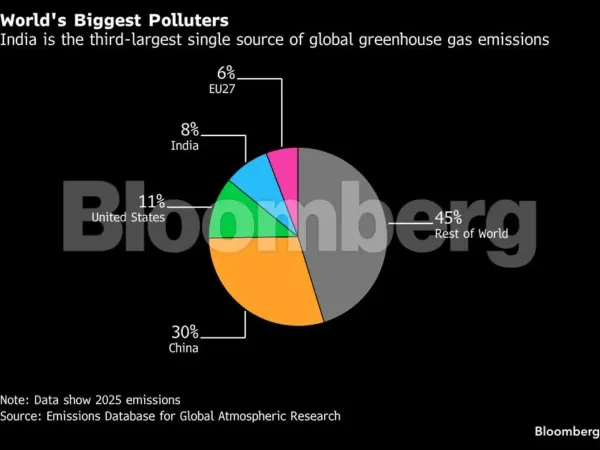
A decision by Prime Minister Narendra Modi’s government in April to withdraw its offer to host the UN talks in 2028 and a revised emissions-cutting strategy seen as lacking in ambition have led some advocates to conclude that India, the world’s third-largest source of greenhouse gas pollution, is quickly retreating from a frontline position on climate diplomacy.
Yet, the nation remains an important voice in closed-door deliberations and a persistent advocate for the developing world’s demands for more climate finance and for industrialized nations to go faster and further in reducing emissions.
And at home, record additions of wind and solar are transforming the roughly $3.9 trillion economy’s coal-dominated power grid, with non-fossil fuel sources accounting for about 30% of the nation’s electricity generation, according to BloombergNEF.
“Developing countries cannot be asked to choose between climate action and the legitimate right to development, to decent living standards, health and education,” Environment Minister Bhupender Yadav told the COP31 talks in a speech Wednesday. “Equitable access to the remaining depleted carbon budget is non-negotiable.”
Despite India’s low public profile in Turkey, the nation is using its influence in negotiations to resist new targets or timetables for climate action that would add obligations on developing nations without offering commitments from richer economies to deliver additional finance or technology.
India is also at the center of two major disputes at the talks — on the timing of the next major global climate-science assessments, and over a proposed goal to accelerate electrification.
The country’s approach “should not be confused with disengagement from climate diplomacy,” said Nakul Sharma, a senior policy adviser at E3G, a climate think tank. “India remains an influential voice in developing country coalitions.”
Along with Russia and Saudi Arabia, India is resisting a timetable to complete and publish three key science reports from the Intergovernmental Panel on Climate Change by 2028. Advocates of the plan insist the documents should be available to inform the next major review of global progress toward the targets of the Paris Agreement, while opponents argue the deadlines don’t offer enough time to include contributions from developing nations.
Separately, the Like-Minded Developing Countries bloc, which includes India and China, has made clear it won’t support top-down targets seeking to raise electricity’s share of global final energy demand to 35% by 2035.
With an accelerating domestic energy transition, it’s a disappointment to climate advocates that India isn’t seeking to push a more ambitious agenda, said Bill Hare, chief executive officer of Berlin-based Climate Analytics, a nonprofit.
India hit a target to raise its share of electricity generation capacity from non-fossil fuel sources to 50% years ahead of schedule though a new goal to reach 60% by 2035 is seen as far too easy to achieve, and lagging well behind the pace of the nation’s renewables boom.
“It’s got massive potential and it’s got so much capacity for clean energy, for clean steel, for clean fertilizer, and for the economic opportunities that come from that,” Hare said. “From an Indian perspective, I would think, we really should be bigger here.”
 Yadav has announced initiatives at COP31 with Japan and Sweden, and held talks with counterparts from the BASIC bloc, which includes Brazil, South Africa and China. Together with Germany’s environment minister Carsten Schneider, he’s also steered consultations on the future of the mitigation work program — an initiative that’s aimed at pressing countries to cut emissions faster.
“India now has the opportunity to use that influence not only to articulate concerns, but also to help build consensus around practical solutions,” said E3G’s Sharma.
Unlike dozens of other nations with flashy promotional pavilions, the country has no dedicated booth at the summit in Antalya, Turkey, and an official delegation of about 152 registered attendees is smaller than those of Bangladesh, Pakistan or Nepal.
A decision by Prime Minister Narendra Modi’s government in April to withdraw its offer to host the UN talks in 2028 and a revised emissions-cutting strategy seen as lacking in ambition have led some advocates to conclude that India, the world’s third-largest source of greenhouse gas pollution, is quickly retreating from a frontline position on climate diplomacy.
Yet, the nation remains an important voice in closed-door deliberations and a persistent advocate for the developing world’s demands for more climate finance and for industrialized nations to go faster and further in reducing emissions.
And at home, record additions of wind and solar are transforming the roughly $3.9 trillion economy’s coal-dominated power grid, with non-fossil fuel sources accounting for about 30% of the nation’s electricity generation, according to BloombergNEF.
“Developing countries cannot be asked to choose between climate action and the legitimate right to development, to decent living standards, health and education,” Environment Minister Bhupender Yadav told the COP31 talks in a speech Wednesday. “Equitable access to the remaining depleted carbon budget is non-negotiable.”
Despite India’s low public profile in Turkey, the nation is using its influence in negotiations to resist new targets or timetables for climate action that would add obligations on developing nations without offering commitments from richer economies to deliver additional finance or technology.
India is also at the center of two major disputes at the talks — on the timing of the next major global climate-science assessments, and over a proposed goal to accelerate electrification.
The country’s approach “should not be confused with disengagement from climate diplomacy,” said Nakul Sharma, a senior policy adviser at E3G, a climate think tank. “India remains an influential voice in developing country coalitions.”
Along with Russia and Saudi Arabia, India is resisting a timetable to complete and publish three key science reports from the Intergovernmental Panel on Climate Change by 2028. Advocates of the plan insist the documents should be available to inform the next major review of global progress toward the targets of the Paris Agreement, while opponents argue the deadlines don’t offer enough time to include contributions from developing nations.
Separately, the Like-Minded Developing Countries bloc, which includes India and China, has made clear it won’t support top-down targets seeking to raise electricity’s share of global final energy demand to 35% by 2035.
With an accelerating domestic energy transition, it’s a disappointment to climate advocates that India isn’t seeking to push a more ambitious agenda, said Bill Hare, chief executive officer of Berlin-based Climate Analytics, a nonprofit.
India hit a target to raise its share of electricity generation capacity from non-fossil fuel sources to 50% years ahead of schedule though a new goal to reach 60% by 2035 is seen as far too easy to achieve, and lagging well behind the pace of the nation’s renewables boom.
“It’s got massive potential and it’s got so much capacity for clean energy, for clean steel, for clean fertilizer, and for the economic opportunities that come from that,” Hare said. “From an Indian perspective, I would think, we really should be bigger here.”
“India now has the opportunity to use that influence not only to articulate concerns, but also to help build consensus around practical solutions,” said E3G’s Sharma.