
For nearly two decades, Lionel Messi has been among the most extraordinary footballers and athletes in the world. What makes him fascinating is not simply the goals he scores, but how he plays.
While others sprint across the field, he often walks. Then, almost without warning, he accelerates, finds an opening and changes the game. Messi’s career offers some surprisingly powerful lessons on investing, as both football and financial markets reward patience, preparation, adaptability and the ability to survive setbacks.
Let time do the heavy lifting
At 13, Messi was a small Argentine boy with prodigious talent and a medical condition that needed costly treatment. FC Barcelona, one of the world’s leading football clubs, saw his potential and supported his development, investing in an uncertain future.
Barcelona wasn’t betting on time alone. It had recognised an exceptional talent worth nurturing. That is how exceptional wealth creation often begins. The opportunity is rarely obvious at the outset. What matters is identifying potential, committing capital and allowing enough time for it to develop.
ALSO READ |
Consider the principle of compounding: Rs.1 crore invested at an annual interest of 12% grows to nearly Rs.3.1 crore in 10 years, Rs.9.6 crore in 20, and Rs.29.9 crore in 30 years. The remarkable part is not just the return, but what time does to it. The greatest advantage in investing is often not extraordinary intelligence, but extraordinary patience.
One of Messi’s unique traits is walking during games. In a widely discussed analysis, he reportedly spent half the game walking. Yet, he is always observing, positioning himself and saving energy for moments that matter—the run needs the walk. Markets have a similar rhythm. Since 2000, the Nifty 50 has closed higher on 54% of trading days and lower on 46%—the rise needs the fall.
Why compounding is time-tested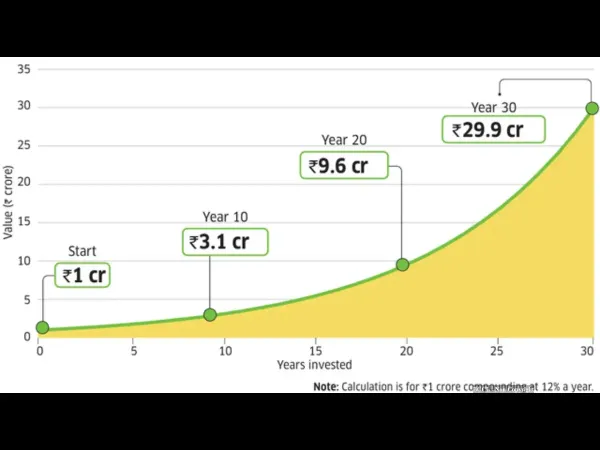 Investors often respond to market inac tivity by switching funds, chasing winners or trying to predict the next move. But activity isn’t the same as progress. A portfolio doesn’t need regular intervention to create wealth. Sometimes, the best move is to let a carefully made investment strategy work.
Rise needs fall: Inactivity doesn’t hamper progress
Even Messi needed a team
Messi is hailed as an individual genius, but some of his greatest feats have come with teammates whose strengths have complemented his. Andrés Iniesta helped control the game, Luis Suárez created chances to score, Dani Alves gave attacking support these abilities made the group stronger.
A winning portfolio needs similar thinking—equities bring potential for long-term growth, debt gives stability and income, and gold can offer diversification in uncertain times. Concentrating wealth in one successful investment can create extraordinary returns, but relying solely on one asset also exposes you to potentially extraordinary losses. Diversification is ensuring that when some investments struggle, others can offer stability.
No rescuing a bad balance sheet
In a shock exit, Messi left Barcelona in 2021, having spent almost his entire career there. Both he and the club wanted to continue the relationship, but Barcelona’s financial difficulties and Spanish football league rules made a deal impossible. The club had one of football’s greatest assets, yet its financial structure couldn’t accommodate him.
There is an investing lesson here: a great property bought with excessive borrowing can become a financial burden. A successful business can fail if it has too much debt. An attractive investment can turn disastrous when leverage forces its sale at the wrong time. Overleverage can turn even a great asset into a terrible investment. Financial resilience is not the enemy of ambition. It allows ambition to survive difficult periods.
What builds wealth may not save it
A young Messi relied on explosive speed and amazing dribbling to beat defenders. As he grew older, he used experience, positioning and passing to influence matches. He remained exceptional because he adapted.
Investors must adopt a similar transition. In the wealth-creation years, measured risks and a meaningful equity exposure may be suitable.
ALSO READ |
Later, when financial independence, retirement or legacy is the priority, protecting accumulated capital becomes important. A portfolio that helped build wealth may need to evolve with financial objectives. The ability that gets you ahead may not be the same as the one that keeps you there.
Stay long enough, story changes
For all his brilliance, Messi faced years of setbacks playing for Argentina. He lost the 2014 World Cup final and two Copa América finals in 2015 and 2016. After that last loss, he briefly retired from international football. But he returned, and won: the 2021 Copa América, the 2022 World Cup, and the 2024 Copa América.
Investing also involves disappointment. Markets crash, strategies fall short and carefully tailored plans see unexpected setbacks. Undergoing a rough year can feel decisive, but the significance of perseverance becomes clear later.
It doesn’t ensure success, but abandoning a sound, long-term strategy due to temporary disappointment can prevent investors from participating in its eventual rewards.
The Author is Managing Director & Founder, Creed Capital
(Disclaimer: The opinions expressed in this column are that of the writer. The facts and opinions expressed here do not reflect the views of )
Contact to : xlf550402@gmail.com
Copyright © boyuanhulian 2020 - 2023. All Right Reserved.