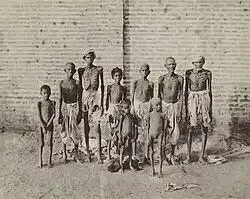
There are some incidents in the history of Rajasthan, the memory of which still leaves a deep impression in the minds of people. One such tragedy was the Chhappaniya famine, which severely affected large parts of Rajasthan and Rajputana during 1899–1900. In this famine, due to lack of rain, crops were ruined, fodder for animals started running out and people faced a serious crisis of food and drinking water. Hunger, disease and migration changed the lives of thousands of villages.
Why was it named Chhappaniya Akal?
Chhappaniya famine got its name from Vikram Samvat 1956. During this same year, the severe famine of 1899-1900 came to be known as Chhappaniya famine in Rajasthan. It is also known in English as The Great Indian Famine of 1899–1900.
This famine was not limited to just one area. Its impact was seen in many areas of western and central India including Rajputana. The farming of Rajasthan at that time was largely dependent on monsoon. Due to lack of rain, crops could not grow in the fields and the rural economy was deeply affected.
How did lack of rain increase the crisis?
In 1899, due to weakening of monsoon, drought situation arose in many areas. There was no grain in the fields and there was shortage of water in ponds, wells and other water sources. The families whose livelihood depended on farming and animal husbandry faced a double challenge.
On one hand, it became difficult for people to get food, while on the other hand, fodder was not available for cows, bulls, camels and other animals. Livestock was an important source of wealth and farming for rural families. The economic condition of the people worsened due to the death of animals and stoppage of farming.
People suffering from hunger, had to leave the village and migrate
During the famine many families had to leave their villages in search of food and water. People started moving to other areas in the hope of employment, food grains and relief. But at that time the means of transportation and communication were limited. It was extremely difficult to cover long distances and gather enough food.
Historical accounts show that the effects of famine were not limited to hunger alone. People also became vulnerable to diseases due to malnutrition and physical weakness. Following the famine, fever and other infectious diseases also increased casualties during 1900 and 1901. In this way, the crisis that started with drought continued to impact people's lives for a long time.
Efforts to save people through relief operations
Arrangements were made for relief work during famine. Historical accounts mention relief efforts and efforts to provide food. However, the scope of the crisis was huge and it was not easy to deliver aid to those in need. Shortages of food, water, employment and animal fodder placed enormous pressure on the relief system.
Why is the memory of Chhappaniya famine still alive?
The Chhappaniya famine became a part of the collective memory of Rajasthan. The difficulties of this period are mentioned in folk tales, folk songs and stories told from elders. It is often remembered as an example of a time when lack of rain affected the livelihood of entire societies.
It is difficult to give the exact figure of how many people died in this famine. Different historical sources provide different estimates, as census, death records and princely states' data were not uniform during that period. However, historical documents confirm that the famine of 1899–1900 was one of Rajputana's most serious humanitarian tragedies.
Contact to : xlf550402@gmail.com
Copyright © boyuanhulian 2020 - 2023. All Right Reserved.