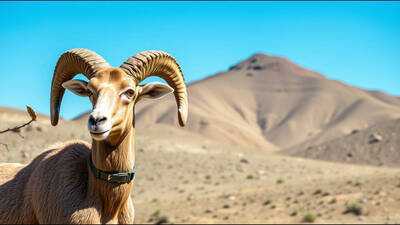
Researchers studying Rocky Mountain bighorn sheep on Antelope Island in Utah have found that data from GPS collars can help estimate when a pregnant female is about to give birth, without requiring researchers to constantly approach or observe the animal. The case report, published in Animal Biotelemetry, examined whether changes in movement recorded by GPS collars could identify the timing of parturition, the biological term for giving birth. Researchers led by Elicia Cotcher and Randy T. Larsen of Brigham Young University analysed changes in step length, velocity, turning angle and seasonal range size in collared females. Using births that were observed in the field to establish movement patterns associated with parturition, the researchers developed a method that estimated birthdates to within 4 days in all of the cases tested. The findings could help researchers identify and conserve birthing habitat while reducing the need for intensive monitoring of pregnant animals.
Movement data was checked against observed births
Between 2020 and 2022, researchers used consistent visual monitoring of collared female Rocky Mountain bighorn sheep on Antelope Island to establish birthdates. They identified 19 birthing events involving 13 females where parturition was observed within 72 hours. The researchers then compared those observations with movement information collected by the animals' GPS collars.
The analysis considered 4 measurements: step length, which records how far an animal moves between GPS fixes; velocity; turning angle, which measures changes in movement direction; and the size of the seasonal range being used by the animal. The approach was based on the analysis of parturition indicators, or the API method, which uses changes in movement behaviour to identify the period around birth. The researchers combined the API measurements with step length to assess whether the GPS data could identify when a female had given birth.
Specific movement changes marked the birthing periodThe study identified a set of movement thresholds associated with parturition in the 13 females used to establish the method. A birth was associated with step length falling below 95 metres, velocity dropping below 0.05 kilometres per hour, a turning angle greater than 1.8 radians and a seasonal range of less than 8 hectares. These changes indicate a marked shift in movement around the time of birth, with females covering shorter distances and using a smaller area.
The researchers then applied the measurements to 34 birthdates involving female bighorn sheep. The combined method identified 19% of births on the observed birthdate itself. That figure increased to 24% when a 1-day window was allowed, 58% within 2 days, 72% within 3 days and 100% within 4 days. In other words, the method was much better at narrowing the birth period to several days than identifying the exact day in every case.
GPS collars could reduce the need for close monitoringThe researchers say conventional approaches to determining birth timing and associated habitat information in wild ungulates can be costly and time-consuming, while direct monitoring can potentially affect females around parturition. GPS collars provide another way of identifying changes in behaviour without requiring researchers to remain close to the animals.
The method also uses movement information from GPS collars that are already being used to monitor the animals, meaning the approach does not require researchers to introduce a separate tracking system specifically for detecting births. The study was conducted with support from Utah State Parks and the Utah Division of Wildlife Resources, while funding came from Brigham Young University and the Utah Division of Wildlife Resources. The researchers note that wildlife biologists involved in the project held the necessary permits and training for capturing, handling and fitting GPS collars to the animals.
The method could help identify birthing habitat
Knowing when females give birth can help researchers understand where bighorn sheep are using the landscape during a particularly important stage of reproduction. The study's authors say combining the API method with step length can estimate birthdates and help with delineating and conserving birthing habitat for bighorn sheep.
The researchers caution, given the nature of the case report, that the method is an approach for estimating parturition timing rather than a system that identifies every birthdate exactly. In the study, only 19% of births were identified on the observed date, although the estimate reached 72% within a 3-day window and 100% within 4 days. The findings therefore suggest that movement data can provide a practical estimate of the birthing period, giving wildlife researchers another tool for studying reproduction and habitat use in wild bighorn sheep.
Contact to : xlf550402@gmail.com
Copyright © boyuanhulian 2020 - 2023. All Right Reserved.