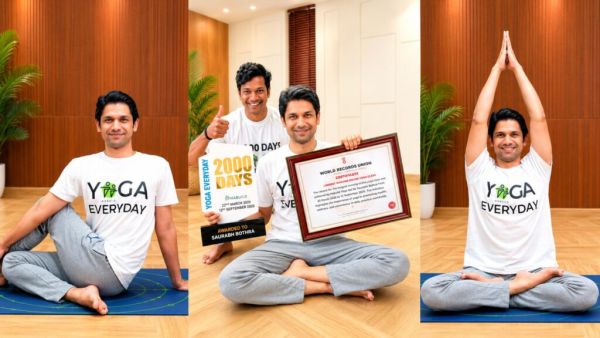
“Even if you start with 5 minutes, it’s a great way to learn to show up. Before focussing on physical strength, stamina, or weight loss, focus on the mental ability of showing up — that’s where all the difference is.”
That’s the philosophy driving Habuild, among India’s fastest-growing online yoga communities, which now counts 19 million members. The Federal spoke to Saurabh Bothra, yoga trainer and co-founder of Habuild, about why consistency is the real fitness problem India needs to solve.
Here are excerpts from the interview:
You’ve built your platform around consistency rather than content — even saying a 5-minute session is worth it. How did you arrive at that focus?
The incident that inspired me happened in my own house. My mom. I’d been telling her to go to the gym, do some workout, and she’d always say house work is her workout. Then one day she came to me with knee pain and asked if I could suggest some asanas to help. I told her it’s not going to help if she doesn’t do it consistently. That’s when I realised that a lot of people, even when they know they need to practise something, are not able to follow through.
That was the spark — the understanding that people want to practise but can’t sustain it, and that consistency is the primary need.
I usually ask people: do you know your health goals? They always say yes — I should lose weight, I should do this, I should do that. Then I ask: do you not have enough information? They say, yeah, we kind of know what we should be doing. So what’s the problem? The problem is that we’re not able to take action, for whatever reason.
Also read | Hatha to Vinyasa to Iyengar, a guide to finding your ideal yoga practice
So I decided I will help people take action rather than educating them more about why they should do something. At Habuild, we have a fundamental policy — we never say Habuild is the best. We tell people: if you know you should be consistent and regular, join our programme and we will help you become consistent. That’s the pitch.
A large chunk of your users are women — mothers, older women — a demographic most fitness tech has missed. How did you reach them?
My mom stays with me, and I’m privileged and lucky to be living with her at a time when most people have had to move to other cities for work. It was very easy for me to take feedback from her — what a mom needs, what a mom shouldn’t be doing — and that helped me build the platform in a way that all moms can appreciate.
Most startups begin with a set protocol: let’s do market research, understand who the paying audience is, map the timing.
We never started with that. We had a clear mission — moms don’t have anything they can turn to, and we will build it for them. There was no market research at all.
We were very mission-oriented. We still carry that motto, even now that we have structure and protocols in place: moms don’t have anything that they can go for, and we should be building it.
Why do you think online yoga has caught on in such a big way in India?
It has not. It feels like it has, but it really hasn’t. India has a population of 150 crore. If even 10 per cent of the people are doing some physical activity, yoga is nowhere close to that.
If 5 crore people can concurrently watch IPL, yoga doesn’t come close to what we call “catching on.” It’s just a fraction right now. A lot more effort is needed, and more people should be building in this space.
Is the lack of direct supervision a stumbling block to people adopting online yoga?
No, I don’t think so. There are two ways to look at it. When you start any exercise, it’s not necessary that you’re doing something so hard it requires posture correction. There are very simple, fundamental movements you can do without supervision.
Lifting your hands up doesn’t require supervision. Moving your legs up and down doesn’t require supervision. Our exercises are as simple as that.
Then how do you describe your brand of yoga? Is it a combination of warm-up, asanas, breathing techniques?
If anyone asks me what kind of yoga we do, we call it fun yoga — whatever makes anyone happy. But yes, a session typically includes warm-up, yoga asanas, breathing, and laughter therapy.
Also read | 5 simple yoga asanas to keep your kidneys healthy
That said, it keeps changing. If you attend different days, you’ll find different components being practised. Most yoga instructors follow a specific school of yoga — ours is fun yoga. We want people to be happy.
You teach seven days a week, all through the year. What do you do to get back on the mat when you’re exhausted?
I sleep. try to get eight hours. Right now it’s a bit disturbed — we’re in the middle of a free 21-day challenge with almost 1.5 million people participating daily — but eight hours is what I aim for.
What is this 21-day challenge?
Every year we run this programme twice — once in June, around International Yoga Day, and once in January, when a lot of people are starting their habit-building journey to practise yoga.
We tell them: “Before you take random steps, focus on consistency of practice. Do yoga with us for 21 days, free of cost. After that, you can decide whether you want to continue with us or try something else.”
That’s what it is. (According to Habuild, lakhs are logging in)
Can you give us a glimpse of your back-end operations — your three offices?
We are three co-founders. I work out of Nagpur, which is our head office and operations base.
The Gurugram office handles everything outward-facing — content, marketing, anything going out to users. The Bengaluru office is all internal — product, tech, data, partnerships. They focus on the tech part of things.
So three co-founders, three different offices, each with a clear focus.
What are your expansion plans — more subscribers, new products, apps?
We don’t focus on expansion as a theme. We start by asking: what is a problem we feel can be solved with technology? What can we do to make exercise, nutrition, and other good habits more accessible to people? That’s our problem statement. Expansion is a byproduct of what we want to do.
What I can tell you is the problem statement we’re currently working on. Right now we have one flagship programme — Yoga Every Day, which I lead. But we believe one programme can never cater to everyone.
So we’re looking at multilingual, multi-trainer, and multi-format. The goal is for Habuild to have, say, 500 instructors teaching in different languages, across different time zones and formats — so more people get access to the kind of exercise they would love.
Are you targeting different languages, or different age groups and needs?
We don’t consider yoga levels in the traditional sense, because online, you can’t progress in levels the way you would in an offline class.
If someone wants to go deeper into their practice, we actually recommend they go offline. We tell them: please take that route.
If you don’t focus on retention strategies, how do you retain members?
That’s not our thing. We’re just trying to add value. If people feel they’re getting something out of it, they will stay. We don’t have a formal retention strategy.
The overall experience has to be good and add value to people’s lives. If they like it, they’ll stay back. If they don’t, it’s absolutely okay if they want to try something else.
What are the dos and don’ts for someone starting online yoga?
Do we tell a child who’s learning to walk about the dos and don’ts of walking? We don’t, right? You just say: try to walk. Starting with don’ts is counterproductive. Before people have even begun, they already have fear — oh, this might happen, that might happen. Talking too much about don’ts usually creates more reasons not to start.
Watch/Read | Aerial Yoga in Chennai: Kids to adults fly to fitness
During the class, I absolutely tell people — don’t do this, don’t do that. But before someone has even started, listing out don’ts doesn’t make sense. It doesn’t help them. It stops them.
Are there any asanas people should avoid doing online?
It’s a very subjective question. It depends on the individual. I personally would never teach a handstand or a full split in an online class — that’s my choice. But there are people who can learn those in a one-on-one setting online.
There’s no blanket rule about what you should or shouldn’t do.
It depends on the setup, the setting, the number of people, who is learning, what the student’s level is, what the teacher’s level is. It can’t have a generic answer.
Your assistant Chotu (Pramod Yadav) has also become very popular. What’s his role going forward?
He has recently gotten a Yoga Mitra certificate, which means he’s also teaching alongside me now. We’ll continue doing that.
The format requires two people, and the amount of dedication and devotion he has for the programme is unmatched. When I’m available, he’s available. If he’s not there, something big is missing from the class. We’ll both continue doing exactly what we’ve been doing.
When you started six years ago, was the format the same?
No, not at all. The entire programme has evolved based on feedback from people. There are things my mom would want me to include, and things I want her to do because they’re important — so the programme is a mix of both.
Music, for instance — it’s not something I would ever do on my own. I include it because I know people enjoy it and asked for it.
Two days a week, 10 minutes of music and movement warm-up — that came from an ask from members. I’m not naturally drawn to it. Why? Because I’m not good at it and I can’t do it well. But it was what people wanted, so it went in.
Are there new asks coming in that you’d like to act on?
Our programme has now reached five to six lakh people on a daily basis, so we’ve seen every type of user, every type of feedback. Right now we’re trying to maintain what we’ve built while also creating an ecosystem around it — something that makes people more regular.
We have a couple of programmes in the pipeline that need proof of concept. They’re still in early stages. The whole idea is to make people show up for yoga every single day. That’s the habit.
Any plans specifically for Yoga Day on the 21st?
We’ve moved away from celebrating just Yoga Day. This year, we’re celebrating the entire yoga week — from the 14th to the 21st. Every day, we’re asking people to participate and practise with us so we can achieve the highest cumulative participation in a week.
We’re already at around 75 lakh people who’ve taken part. If you consider even five days of practice, that works out to about 15 lakh people on a daily basis.
Can you talk about the benefits of yoga?
Google is filled with that. I stopped talking about the benefits of yoga in 2020. If you’re still questioning the benefits of yoga in today’s world, I doubt you even want to practise it. Information is freely available. Everyone knows the benefits of exercise, the benefits of yoga.
During Covid, there was new research every single day — this breathing technique helps with this, that helps with that. I’m not someone who talks about benefits. I tell people: if you know the benefits, practise it. If you don’t, it’s okay — do something else. I’m not going to convince you to do yoga. Just get on the mat if you want to come.
We’re not trying to tell people yoga is good. We’re trying to tell people: if you already know yoga is good, be consistent with it. There is a big difference in what we’re trying to do.
Contact to : xlf550402@gmail.com
Copyright © boyuanhulian 2020 - 2023. All Right Reserved.