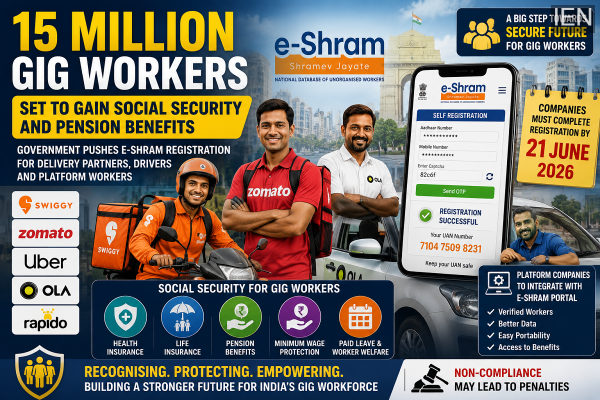
E-Shram Registration Drive Could Benefit More Than 15 Million Delivery Partners and Drivers
India's rapidly expanding gig economy is set for a major transformation as the government moves to bring millions of platform-based workers under a formal social security framework. Companies operating through app-based platforms have been instructed to register their gig workforce on the e-Shram portal, a move that could pave the way for benefits such as insurance, pension coverage, and improved worker protections.
The initiative is expected to impact delivery executives, ride-hailing drivers, and other platform workers associated with digital services. Industry observers believe the move represents one of the most significant policy efforts aimed at improving welfare and financial security for gig workers in India.
Government Pushes for Comprehensive Worker Registration
Authorities have directed major app-based platforms to ensure that workers operating through their networks are registered on the e-Shram portal within the specified timeline.
The registration drive is aimed at creating a centralized database of gig and platform workers across the country. By bringing workers into a unified system, the government hopes to improve policy planning and ensure that welfare benefits reach eligible individuals more efficiently.
The initiative covers workers associated with food delivery, ride-hailing, logistics, and other digital service platforms that have become a major source of employment in recent years.
Why E-Shram Registration Matters
The e-Shram portal serves as a national database for workers in the unorganized sector. Once registered, workers receive a unique identification number that can help them access government welfare schemes and social security programs.
The registration process is expected to provide several long-term advantages:
Creation of a verified worker identity
Easier access to welfare benefits
Better portability across states and employers
Improved tracking of employment trends
Inclusion in future social security programs
For many gig workers who frequently switch platforms or work in multiple cities, portability could become a significant advantage.
Social Security Benefits May Expand
One of the primary objectives of the initiative is to extend social security coverage to a segment of the workforce that has traditionally lacked formal protections.
Under evolving labor and social security regulations, registered gig workers may become eligible for benefits such as:
Health Insurance
Medical coverage can help workers manage healthcare expenses and reduce financial stress during emergencies.
Life Insurance Protection
Insurance benefits can provide financial support to families in the event of unforeseen circumstances.
Pension Opportunities
Long-term retirement savings and pension schemes could help workers build financial security beyond their active earning years.
Welfare Support Programs
Registration may also improve access to various government assistance programs designed for workers in the informal sector.
Towards a More Structured Gig Economy
India's gig economy has expanded rapidly over the last decade, driven by digital platforms and increasing demand for on-demand services.
Despite this growth, many workers have operated without formal employment benefits that are commonly available in traditional jobs. Policymakers now aim to create a more balanced framework that supports both innovation and worker welfare.
Experts believe the formalization process could improve transparency, accountability, and long-term sustainability within the sector.
Discussion Around Minimum Wage and Working Conditions
A major area of focus is the development of standards related to worker welfare.
Policymakers and labor experts have been discussing measures that may eventually strengthen protections related to:
Fair compensation
Working hours
Occupational safety
Leave benefits
Social security coverage
While implementation details may evolve over time, the broader objective is to ensure that gig workers receive greater economic and social protection.
Companies Expected to Integrate Systems
To support the registration drive, platform operators are expected to integrate their systems with the e-Shram infrastructure.
This integration would help streamline worker verification, improve data accuracy, and facilitate benefit delivery.
Authorities believe that better coordination between government databases and platform companies can help create a more efficient and transparent ecosystem for workers.
Non-Compliance Could Invite Regulatory Action
The government has indicated that adherence to the registration framework is important for platform operators.
Companies that fail to meet compliance requirements could face regulatory scrutiny or other consequences under applicable rules. This emphasis highlights the seriousness of the government's efforts to formalize the sector and expand worker protections.
A Significant Step for India's Workforce
The latest initiative reflects a broader effort to recognize the growing importance of gig workers in India's economy. From food delivery executives and ride-hailing drivers to logistics personnel and service providers, millions of workers contribute to the country's digital economy every day.
By encouraging large-scale e-Shram registration and expanding access to social security benefits, the government aims to create a stronger support system for this workforce. If implemented effectively, the move could mark a major shift toward greater financial security, improved welfare coverage, and a more structured future for India's gig economy.
Contact to : xlf550402@gmail.com
Copyright © boyuanhulian 2020 - 2023. All Right Reserved.