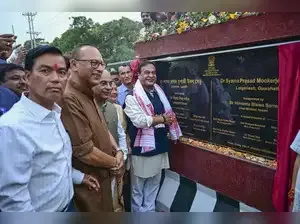
Guwahati: Chief Minister Himanta Biswa Sarma formally inaugurated the newly constructed Dr. Syama Prasad Mookerjee Flyover at Lalganesh in Guwahati, adding yet another landmark to Assam’s transport infrastructure. The flyover has been completed in just 26 months, as against the stipulated timeline of 30 months at a cost of Rs. 376 crore.
Addressing his first public function after assuming the office of the Chief Minister for a second term, Sarma said that the flyover, constructed from the Cycle Factory junction on the Guwahati-Garbhanga Road to Lalganesh and named after eminent educationist and visionary statesman Dr Syama Prasad Mookerjee, is the first flyover to be inaugurated during the government’s second term.
He observed that the day would always be remembered as a milestone in the state government’s mission to propel Assam forward on an unstoppable path of development.
The Chief Minister stated that the government had envisioned the flyover project to make Guwahati’s traffic management more dynamic, disciplined and modern. Extending from the Cycle Factory junction to Lalganesh, the major flyover project is expected to significantly improve connectivity in the south-western part of the city.
Referring to the approximately 2.8-kilometre-long flyover, he said that with its inauguration, uninterrupted and faster vehicular movement would now be ensured from Arya Nagar to the Lakhra stretch of National Highway 27.
He added that thousands of daily commuters, including people travelling for medical treatment, education and employment, would benefit immensely from the project.
The Chief Minister further noted that patients travelling to medical institutions such as the Dr. B. Borooah Cancer Institute, Pragjyotishpur Medical College and several other hospitals located near the National Highway would find commuting more convenient through the flyover.
He also said that the flyover would facilitate smoother access to the Integrated Directorate Complex being constructed at Betkuchi as well as the Barsapara Cricket Stadium. In addition to the main three-lane flyover, 6-metre-wide service roads on both sides of the flyover and 2-metre-wide RCC drains would help streamline and decongest local traffic along the Guwahati-Garbhanga Road, along with free flow of water.
The Chief Minister informed that under the project, a 320-metre-long connecting road towards the Barsapara Cricket Stadium would also be constructed in the future, enabling direct access to the stadium through the flyover. Similarly, provision has been kept for the construction of a 330-metre-long intermediate road towards the Cycle Factory side to help manage future traffic pressure.
The Chief Minister said that the newly constructed flyover has been dedicated in the name of the great nationalist leader Dr. Syama Prasad Mookerjee, who dedicated his life for “One Nation, One Flag, One Constitution.”
Referring to the close association of Dr. Mookerjee and his father Ashutosh Mukherjee with Assam, the Chief Minister stated that Sir Ashutosh Mukherjee played a pioneering role in starting the Assamese language studies in higher education under the University of Calcutta. During his visit to the then Cotton College in 1918, Ashutosh Mookherjee had encouraged Hemchandra Goswami to compile literary works from the ancient and medieval periods of Assamese literature, and in 1919 he appointed Ambikanath Bora, son of Satyanath Bora, to the University of Calcutta.
The Chief Minister further mentioned that under the initiative of Dr. Syama Prasad Mookerjee, who later became Vice-Chancellor of the University of Calcutta, the proposal for imparting school education in the Assamese medium, especially for entrance examinations, was adopted.
He said Assamese was introduced as a medium of instruction up to matriculation largely due to Dr. Mookerjee’s keen interest and efforts. He also noted that Dr. Mookerjee played a vital role in securing recognition for J.B. College under the University of Calcutta and strongly supported the demand for establishing a separate university for Assam.
The Chief Minister stated that Dr. Mookerjee recognised Assam’s distinct cultural and intellectual identity and supported the aspiration for a university tailored to the State’s unique requirements. According to Dr. Mookerjee, Assam possessed immense academic potential in disciplines such as language, anthropology, geology, botany and forestry, all of which carried special scholarly importance.
The Chief Minister remarked that Dr. Mookerjee believed a university in Assam would emerge as a nationally significant centre for advanced research and for the preservation and growth of the Assamese language and culture. At a time when public enthusiasm for the university movement had occasionally weakened, the support of a personality like Dr. Mookerjee infused new confidence and moral strength among the people of Assam.
The Chief Minister observed that beyond the field of education, Dr. Syama Prasad Mookerjee also left an indelible impact on Assam’s political history. During the Partition of India, his support in ensuring that Assam remained within India alongside West Bengal greatly strengthened Lokapriya Gopinath Bordoloi and the people of Assam. Referring to the turbulent years of 1940-41, when Assam faced intense political uncertainty and demographic and communal concerns, Dr. Mookerjee stood firmly with the people of Assam, the Chief Minister added.
Addressing his first public function after assuming the office of the Chief Minister for a second term, Sarma said that the flyover, constructed from the Cycle Factory junction on the Guwahati-Garbhanga Road to Lalganesh and named after eminent educationist and visionary statesman Dr Syama Prasad Mookerjee, is the first flyover to be inaugurated during the government’s second term.
He observed that the day would always be remembered as a milestone in the state government’s mission to propel Assam forward on an unstoppable path of development.
The Chief Minister stated that the government had envisioned the flyover project to make Guwahati’s traffic management more dynamic, disciplined and modern. Extending from the Cycle Factory junction to Lalganesh, the major flyover project is expected to significantly improve connectivity in the south-western part of the city.
Referring to the approximately 2.8-kilometre-long flyover, he said that with its inauguration, uninterrupted and faster vehicular movement would now be ensured from Arya Nagar to the Lakhra stretch of National Highway 27.
He added that thousands of daily commuters, including people travelling for medical treatment, education and employment, would benefit immensely from the project.
The Chief Minister further noted that patients travelling to medical institutions such as the Dr. B. Borooah Cancer Institute, Pragjyotishpur Medical College and several other hospitals located near the National Highway would find commuting more convenient through the flyover.
He also said that the flyover would facilitate smoother access to the Integrated Directorate Complex being constructed at Betkuchi as well as the Barsapara Cricket Stadium. In addition to the main three-lane flyover, 6-metre-wide service roads on both sides of the flyover and 2-metre-wide RCC drains would help streamline and decongest local traffic along the Guwahati-Garbhanga Road, along with free flow of water.
The Chief Minister informed that under the project, a 320-metre-long connecting road towards the Barsapara Cricket Stadium would also be constructed in the future, enabling direct access to the stadium through the flyover. Similarly, provision has been kept for the construction of a 330-metre-long intermediate road towards the Cycle Factory side to help manage future traffic pressure.
The Chief Minister said that the newly constructed flyover has been dedicated in the name of the great nationalist leader Dr. Syama Prasad Mookerjee, who dedicated his life for “One Nation, One Flag, One Constitution.”
Referring to the close association of Dr. Mookerjee and his father Ashutosh Mukherjee with Assam, the Chief Minister stated that Sir Ashutosh Mukherjee played a pioneering role in starting the Assamese language studies in higher education under the University of Calcutta. During his visit to the then Cotton College in 1918, Ashutosh Mookherjee had encouraged Hemchandra Goswami to compile literary works from the ancient and medieval periods of Assamese literature, and in 1919 he appointed Ambikanath Bora, son of Satyanath Bora, to the University of Calcutta.
The Chief Minister further mentioned that under the initiative of Dr. Syama Prasad Mookerjee, who later became Vice-Chancellor of the University of Calcutta, the proposal for imparting school education in the Assamese medium, especially for entrance examinations, was adopted.
He said Assamese was introduced as a medium of instruction up to matriculation largely due to Dr. Mookerjee’s keen interest and efforts. He also noted that Dr. Mookerjee played a vital role in securing recognition for J.B. College under the University of Calcutta and strongly supported the demand for establishing a separate university for Assam.
The Chief Minister stated that Dr. Mookerjee recognised Assam’s distinct cultural and intellectual identity and supported the aspiration for a university tailored to the State’s unique requirements. According to Dr. Mookerjee, Assam possessed immense academic potential in disciplines such as language, anthropology, geology, botany and forestry, all of which carried special scholarly importance.
The Chief Minister remarked that Dr. Mookerjee believed a university in Assam would emerge as a nationally significant centre for advanced research and for the preservation and growth of the Assamese language and culture. At a time when public enthusiasm for the university movement had occasionally weakened, the support of a personality like Dr. Mookerjee infused new confidence and moral strength among the people of Assam.
The Chief Minister observed that beyond the field of education, Dr. Syama Prasad Mookerjee also left an indelible impact on Assam’s political history. During the Partition of India, his support in ensuring that Assam remained within India alongside West Bengal greatly strengthened Lokapriya Gopinath Bordoloi and the people of Assam. Referring to the turbulent years of 1940-41, when Assam faced intense political uncertainty and demographic and communal concerns, Dr. Mookerjee stood firmly with the people of Assam, the Chief Minister added.