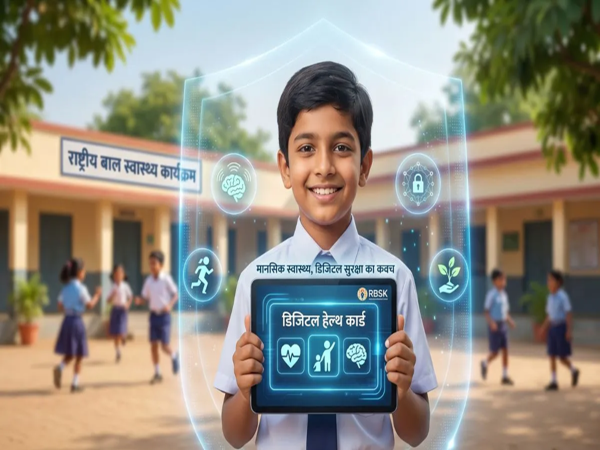
The Ministry of Health and Family Welfare recently introduced new guidelines for the 'Rashtriya Bal Swasthya Karyakram' (RBSK) 2.0 during the 'National Summit on Good Practices and Innovations in Public Healthcare Delivery.' These guidelines were officially launched at the recently concluded 'National Summit on Good Practices and Innovations in Public Healthcare.' The government states that these updates are grounded in the experiences of the past decade and have been formulated with the evolving health needs of children in mind.
**Digital Health Cards for Children Up to 18 Years of Age**
The new guidelines now extend coverage to children ranging from birth to 18 years of age. Under this framework, a continuous process has been initiated to protect children from diseases, promote their health, and facilitate their treatment. This entire process is being digitized. Digital health cards will be generated for children, and a real-time database will be established to facilitate easier health monitoring. Additionally, a robust 'Referral Tracking System' will be implemented to ensure that services become more effective and transparent.
A direct benefit of this initiative is that if a child is diagnosed with an ailment during a grassroots-level screening, their entire journey—from treatment at a major hospital through to recovery—will be comprehensively tracked. This will ensure that no child falls through the cracks during the course of treatment and that they receive timely medical assistance.
**Mobile Health Teams to Reach Anganwadis and Schools**
To ensure the success of this comprehensive health scheme, the Departments of Health, Education, and Women and Child Development have been brought together on a single platform to foster better coordination and collaboration at every level. As in the past, the physical and mental health screenings of children will be conducted at Anganwadi centers and schools through the deployment of mobile health teams. This approach will ensure that the benefits of the scheme reach children from all sections of society. Schools and Anganwadi centers will serve as pivotal hubs for raising health awareness among children and for monitoring their medical treatment. The Ministry of Health anticipates that these digital innovations and the new strategic approach will bring about greater transparency and efficiency in the implementation of the scheme.
Examination Methodology to Change: The Traditional '4D' Approach Has Been Expanded
Under the previous system, the primary focus was on the established '4D' approach (birth defects, diseases, deficiencies, and developmental delays). However, under the new guidelines, the scope of this approach has been expanded. Now, children will also be screened and treated for non-communicable diseases (such as diabetes and hypertension), mental health conditions, and behavioral issues. The government's primary objective is no longer merely to ensure the survival of children, but to ensure their holistic development.
Disclaimer: This content has been sourced and edited from Amar Ujala. While we have made modifications for clarity and presentation, the original content belongs to its respective authors and website. We do not claim ownership of the content.
Contact to : xlf550402@gmail.com
Copyright © boyuanhulian 2020 - 2023. All Right Reserved.