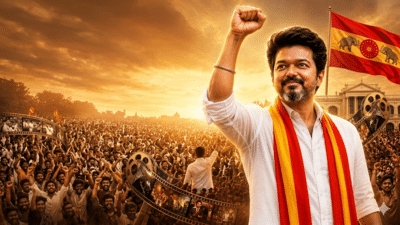
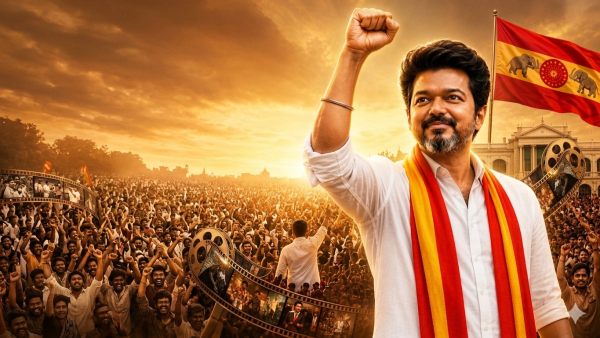
His party, Tamilaga Vetri Kazhagam (TVK), has reportedly made a strong electoral debut, securing over 100 seats and disrupting the long-standing dominance of Dravidian majors like Dravida Munnetra Kazhagam and All India Anna Dravida Munnetra Kazhagam.
Early Life and Film Career: Foundations of Mass Appeal
Born on June 22, 1974, in Chennai, Vijay hails from a family deeply embedded in the Tamil film industry. His father, S. A. Chandrasekhar, is a noted filmmaker, while his mother, Shoba Chandrasekhar, is a singer.
Vijay’s early exposure to cinema translated into a career that, despite initial criticism, evolved into one of Tamil cinema’s most successful trajectories. Films such as Ghilli, Mersal, and Sarkar not only cemented his mass appeal but increasingly carried socio-political undertones, hinting at his future ambitions.
From Stardom to Political Assertion
Unlike earlier actor-politicians in Tamil Nadu, Vijay’s political journey has been marked by a deliberate distancing from familial or inherited political structures. A notable episode was his public disapproval of a political outfit launched in his name by his father, underscoring his insistence on independent political legitimacy.
This assertion of autonomy became a defining feature of his political persona—one that seeks to balance celebrity influence with ideological positioning.
The Formation of TVK and a Strategic Exit from Cinema
In February 2024, Vijay formally launched Tamilaga Vetri Kazhagam, signalling a decisive shift from cinema to public life. At the peak of his film career, his announcement to step away from acting surprised both industry observers and political analysts.
His first major political rally in Vikravandi drew massive crowds, reflecting a transfer of cinematic fandom into political mobilisation. Declaring his final film as Thalapathy 69, Vijay framed his political plunge as a commitment to public service rather than a parallel pursuit.
Ideological Positioning: Between Dravidian Legacy and Reform
Vijay’s articulation of ideology attempts a careful balancing act. He has invoked the legacy of Periyar E. V. Ramasamy, particularly in areas of social justice and gender equality, while distancing himself from strict atheistic interpretations.
His emphasis on:
- Secularism and social justice
- Two-language policy (Tamil and English)
- Caste census for equitable policy-making
suggests a calibrated attempt to align with Dravidian political ethos while presenting a reformist alternative.
The 2026 Electoral Upset: A Structural Shift?
The 2026 Tamil Nadu Assembly election results indicate more than a routine electoral shift. TVK’s performance appears to have dented traditional vote banks, signalling voter fatigue with entrenched political formations.
Political observers interpret this outcome through multiple lenses:
- Charismatic mobilisation: Vijay’s personal appeal translating into votes
- Anti-incumbency sentiment: A desire for systemic change
- Youth engagement: A new demographic entering the political mainstream
Yet, questions remain about whether this momentum can sustain governance challenges beyond electoral success. ALSO READ: Tamil Nadu Assembly Election 2026: Corruption, Drugs Crisis, and Anti-Vijay Sentiment — The Real Reasons Behind DMK’s Defeat
Personal Life: A Quiet Anchor
Away from the political spotlight, Vijay’s personal life has remained relatively understated. Married to Sangeeta Sornalingam since 1999, his family has largely stayed out of public political discourse, reinforcing his image as a leader focused on public issues rather than dynastic politics.
Conclusion: A New Chapter or a Familiar Pattern?
The rise of Joseph Vijay Chandrasekhar underscores a familiar yet evolving pattern in Tamil Nadu—where cinema continues to serve as a springboard for political legitimacy. However, Vijay’s emphasis on ideological clarity and organisational independence marks a nuanced departure from predecessors.
Whether this moment represents a durable political transformation or a transient wave driven by charisma will depend on how effectively TVK transitions from electoral success to administrative credibility.
For now, Tamil Nadu stands at a political inflection point—one where a film icon has redefined the contours of contemporary Dravidian politics.
Contact to : xlf550402@gmail.com
Copyright © boyuanhulian 2020 - 2023. All Right Reserved.