
Arsenal have announced yet another loss in their latest round of accounts. For the financial year ending May 31, 2025, the club have seen a loss of £1.7million.
This can be absorbed in a number of ways, especially given that the club only recently announced that, for the fifth consecutive season, ticket prices will increase on average by 3.9%. It is the seventh straight year the club has announced it has made a loss.
For a club operating in the UEFA Champions League, competing at the top end of the Premier League and in the latter stages of most competitions, this might come as a surprise. Especially when the last time the club announced a profit was in 2018.
- Martin Odegaard future clarified as Arsenal captain sets sights on major career moment
- Bayer Leverkusen duo make surprise Arsenal claim ahead of Champions League draw
FOLLOW OUR ARSENAL FB PAGE! Latest Gunners news, analysis and much more via our dedicated Facebook page
However, delve deeper into the numbers, and this loss actually looks rather positive. Yet there are still some questions that need answering.
When you look at the year-on-year financial results since 2018, the year that the club was bought out by Kroenke Sports Entertainment, you see an immediate nosedive. That stopped suddenly in 2021, when we hit the period after the COVID-19 pandemic.
And, just like the results on the pitch, the financial results begin to improve. This is where the core positive outcome comes from despite the loss is since 2021, where the club recorded a £107.3million loss, which was noted to be considerably due to the impact of the pandemic, it has considerably improved.
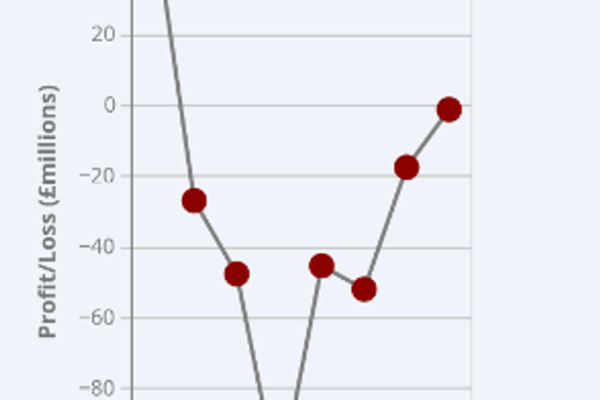
A big factor has been Arsenal’s performances on the pitch and re-establishment both as Premier League title challengers but predominantly qualification and strong performances in the UEFA Champions League. After several years out of the competition, the club reached the quarter-finals of the competition in 2024 for the first time in 14 years.
The numbers have risen despite considerable investment in the team, too, and an increase in the outlay on wages. It has reached a new high of £346.8million in 2025, but it is worth noting that, just like across the last nine years prior to this, it remains below that of Manchester City.
In fact, this new data shows that over the last ten financial years, Manchester City have spent around £870.048millionmore on player wages, compared to Arsenal. So when Pep Guardiola starts talking about “net spend” he would be best reminded to have a look at this figure that is often overlooked.
There is, however, a rather big question that needs answering. If you look at the last three years of Arsenal’s financial results, and specifically the “other operating charges”.
In 2023, this came to £112.557million, and grew to £146.774million in 2024. In 2025, this “rose sharply”, as the club describes it, to £200.756million.
This means in the space of two years, these “other operating charges” have grown by £88.199million. The club says this is due to “reflecting increased staging costs, specific direct costs of delivering increased revenues, certain residual property matters and inflationary pressures".
Beyond this, there is very little to explain what it is these are making it difficult to understand how this could have increased to this degree. Perhaps in time, more information will come out.
Another reason for the improved figures is the player sales element. Arsenal posted an improvement from £52.4million on player sales in 2024 to £81.7million in 2025.
This was much helped by the sales of Eddie Nketiah, Aaron Ramsdale and Emile Smith Rowe. In the summer of 2025, which will be reflected in next year’s accounts, Arsenal’s sales were dramatically less with meagre fees earned for the likes of Nuno Tavares, Oleksandr Zinchenko, Marquinhos and Albert Sambi Lokonga in addition to some loan fees for Jakub Kiwior, Fabio Vieira and Ethan Nwaneri.
If Arsenal are to post a profit next year, this will be a significant chasm that will have to be made up elsewhere. Reaching the semi-finals of the UEFA Champions League, further improved broadcast revenue, alongside other benefits, will help.
Ultimately, with Arsenal’s improvements on the field, this is a case of correlation being causation and it significantly helping the club financially. That being said, those expecting therefore big money to be available in the summer of 2026 should remember just how much the club spent in the summer of 2025 with Piero Hincapie’s deal still yet to be paid for too.
Player sales to fund further transfers, in addition to the sheer volume of players in the squad is therefore expected. Do not be surprised if the likes of Gabriel Jesus, Gabriel Martinelli, Ben White, Myles Lewis-Skelly or even Ethan Nwaneri could be subject to serious interest during the summer transfer window.
Certainly, there will be reluctance to see some leave, but as Arsenal move into a different sphere as a club, the big teams sometimes lose well-established players and ruthlessly replace them with better ones. Even their most exciting young prospects if pathways become jammed, look at Cole Palmer at Manchester City and Jarrel Quansah at Liverpool as examples.
If it happens, and I should stress it remains an “if” for now, it will be a shock simply because it has not been the norm for the club but as you get better, and establish yourself at the top big things change.
Ensure our latest sport headlines always appear at the top of your Google Search by making us a Preferred Source. Click here to activate or add us as Preferred Source in your Google search settings
Contact to : xlf550402@gmail.com
Copyright © boyuanhulian 2020 - 2023. All Right Reserved.