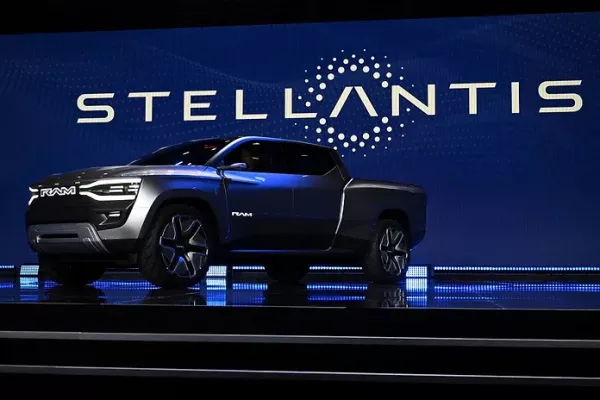
Stellantis just sent one of the clearest signals yet that the global EV transition isn’t moving at the pace many boardrooms once assumed. The automaker took a €22.2 billion write-down last year, largely tied to scaling back electric vehicle programs. But the real headline isn’t the number. It’s the admission behind it.
Stellantis openly acknowledged that it moved faster than customers were ready to follow.
That line alone sets this moment apart from similar pullbacks across the industry.
A Rare Admission From the C-Suite
CEO Antonio Filosa didn’t soften the message. He said the company “over-estimated the pace of the energy transition” and allowed long-term electrification targets to override what buyers were actually choosing in showrooms.
The consequences were expensive. Cancelled EV products. Impaired electric platforms. Battery operations scaled down before they ever reached full stride. At one point, Stellantis was targeting 50 percent EV sales in the U.S. and a fully electric Europe by 2030. Today, EV adoption in the U.S. still hovers around 7 percent.
The mismatch between ambition and reality finally caught up.
Capital Follows Demand, Not Declarations
What this reset looks like in practice is straightforward. Stellantis is redirecting capital toward hybrids and internal combustion models where demand is proven and margins are clearer. EV investment isn’t disappearing, but it’s being paced by actual buying behavior instead of regulatory timelines and investor decks.
This approach mirrors a growing industry trend. Ford has publicly shifted toward demand-led EV programs, focusing on affordability rather than volume. Even premium brands like Porsche are rumored to be rethinking all-electric futures for sports car nameplates.
Meanwhile, competition in the EV space has intensified dramatically. Chinese automakers, in particular, are flooding global markets with lower-cost electric options, making profitability harder for legacy manufacturers.
North America Leads the Pivot
Nowhere is Stellantis’s strategy change more visible than in North America. The company has cancelled its planned electric Ram 1500 pickup and is bringing the HEMI V8 back into the Ram lineup. Hybrid powertrains are expanding across multiple brands, and Stellantis has rolled out five new vehicles along with 19 additional product actions tailored to regions where ICE still dominates.
This isn’t nostalgia-driven engineering. It’s math.
Pickups, V8s, and hybrids still pay the bills, especially in markets where charging infrastructure, pricing, and consumer trust remain barriers to EV adoption.
The Industry Is Quietly Resetting Expectations
Stellantis isn’t alone in absorbing EV- losses. Ford recorded a $19.5 billion write-down, while GM took a $6 billion hit in 2025. The difference is tone. Stellantis is saying out loud what many others are hinting at.
The transition was pushed ahead of customer readiness.
What this really means is that the next decade of auto industry profitability may not be won by forcing electrification timelines, but by offering choice. Hybrids. Efficient ICE vehicles. EVs where they genuinely make sense.
The recalibration is underway. And for the first time in years, the industry seems to be listening to buyers instead of lecturing them.
Contact to : xlf550402@gmail.com
Copyright © boyuanhulian 2020 - 2023. All Right Reserved.