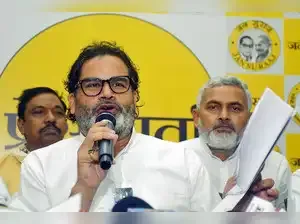
New Delhi: Supreme Court on Friday refused to entertain a plea moved by the Jan Suraaj Party, alleging misuse of a state welfare scheme to influence voters ahead of the 2025 Bihar assembly election.
A bench comprising Chief Justice of India Surya Kant and justice Joymalya Bagchi hauled up the party, founded by political strategist Prashant Kishor, for trying to use the court to secure relief after having lost polls.
"How many votes did you get? Once people reject you, you use the judicial forum to get relief! Somebody should have challenged the scheme itself then. That is not the prayer before us. You just want the election to be declared null and void," CJI Kant observed. The bench said the high court would be the appropriate judicial forum to decide the matter.
Kishor's party had contested 242 of the 243 assembly seats in the assembly polls but failed to secure a single seat. "Since it deals with only one state, please go to that high court. In some cases, there is a serious issue of freebies, which we will seriously examine," CJI Kant told the petitioner's counsel.
He said while the top court would examine the issue of freebies, it would also have to see the bona fides of the petitioner. "We will consider the freebies issue. But we have to see the bona fide also... We cannot look at that at the behest of a party which has just lost. When you come to power, you will do the exact thing," the CJI said. The petition was eventually withdrawn.
Kishor's party had challenged a scheme launched by the Nitish Kumar-led Bihar government just before the election - the Mukhyamantri Mahila Rojgar Yojana - under which the state decided to provide ₹10,000 grant to one woman in every family to start small businesses, with a further promise of ₹2 lakh after assessment.
According to the petitioner, eligibility for the scheme was linked to membership of JEEVIKA, a network of women's self-help groups. The state announced that women not already part of JEEVIKA could enrol to receive the benefit.
Jan Suraaj Party alleged that while around 10 million women were already associated with JEEVIKA before the Model Code of Conduct came into force, newspaper reports later showed that 15.6 million women eventually received payments. The petitioner argued that releasing cash benefits during this period amounted to "corrupt practices" meant to unduly influence voters in favour of the ruling coalition.
A bench comprising Chief Justice of India Surya Kant and justice Joymalya Bagchi hauled up the party, founded by political strategist Prashant Kishor, for trying to use the court to secure relief after having lost polls.
"How many votes did you get? Once people reject you, you use the judicial forum to get relief! Somebody should have challenged the scheme itself then. That is not the prayer before us. You just want the election to be declared null and void," CJI Kant observed. The bench said the high court would be the appropriate judicial forum to decide the matter.
Kishor's party had contested 242 of the 243 assembly seats in the assembly polls but failed to secure a single seat. "Since it deals with only one state, please go to that high court. In some cases, there is a serious issue of freebies, which we will seriously examine," CJI Kant told the petitioner's counsel.
He said while the top court would examine the issue of freebies, it would also have to see the bona fides of the petitioner. "We will consider the freebies issue. But we have to see the bona fide also... We cannot look at that at the behest of a party which has just lost. When you come to power, you will do the exact thing," the CJI said. The petition was eventually withdrawn.
Kishor's party had challenged a scheme launched by the Nitish Kumar-led Bihar government just before the election - the Mukhyamantri Mahila Rojgar Yojana - under which the state decided to provide ₹10,000 grant to one woman in every family to start small businesses, with a further promise of ₹2 lakh after assessment.
According to the petitioner, eligibility for the scheme was linked to membership of JEEVIKA, a network of women's self-help groups. The state announced that women not already part of JEEVIKA could enrol to receive the benefit.
Jan Suraaj Party alleged that while around 10 million women were already associated with JEEVIKA before the Model Code of Conduct came into force, newspaper reports later showed that 15.6 million women eventually received payments. The petitioner argued that releasing cash benefits during this period amounted to "corrupt practices" meant to unduly influence voters in favour of the ruling coalition.