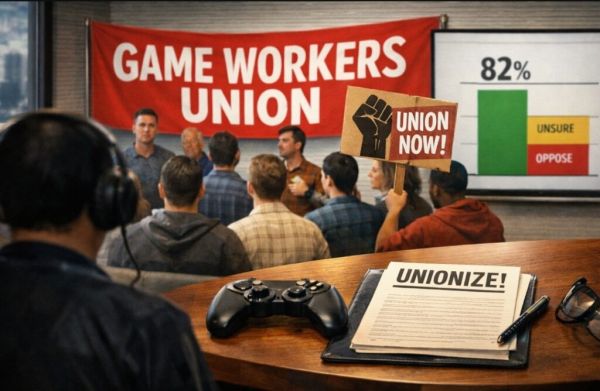
Support for labor unions among video game developers in the United States has reached a notable high, according to findings from the 2026 State of the Game Industry (SOTI) survey. The data points to a workforce that is increasingly aligned around the idea of collective organization, driven by ongoing concerns over job security, pay structures, and long-standing workplace challenges within the game development sector.
The SOTI survey is conducted annually by the GDC Festival of Gaming and draws responses from thousands of professionals across the global game industry. This year’s edition included input from more than 2,300 respondents, offering a detailed look at how developers view the current state of their industry and their own working conditions. Among U.S.-based respondents, support for unionization stood out as one of the strongest signals of shifting labor attitudes.
Broad Support Among U.S.-Based Developers
The survey found that 82 percent of game developers working in the United States support the unionization of game industry workers. This overwhelming majority suggests that collective bargaining is increasingly viewed as a viable solution to many of the structural problems developers face, particularly in an industry marked by cyclical employment and frequent layoffs.
In contrast, only 5 percent of U.S. respondents said they oppose unionization outrightindicating limited resistance among the broader workforce. An additional 13 percent said they were unsurereflecting some lingering hesitation but not outright rejection of organized labor. Together, the numbers paint a picture of an industry where support for unions has become mainstream rather than fringe.
Income, Age, and Layoff Experience Influence Opinions
The survey results also revealed that support for unionization varies depending on economic circumstances and career experiences. Developers earning under $200,000 annually were significantly more likely to support union efforts compared to those with higher incomes. This suggests that workers who feel more financially vulnerable may see unions as a way to improve stability and negotiating power.
Layoff history played a major role as well. Developers who reported being laid off at least once in the past two years expressed higher levels of support for unionization than those who had not experienced recent job loss. The game industry has seen widespread layoffs over the past several years, affecting studios large and small, and leaving many workers uncertain about long-term career security.
Age also influenced responses. Developers under the age of 45 showed stronger backing for unionization than older respondents. This generational difference may reflect changing expectations about workplace protections, transparency, and sustainable career paths in an industry traditionally known for long hours and intense production schedules.
Leadership Views Are More Mixed
While overall support for unionization was strong, opinions were more divided among respondents in leadership roles, including studio owners and executives. Among this group, 58 percent said they support unionizationstill a majority but notably lower than the level of support seen among non-leadership workers.
At the same time, 18 percent of leaders said they oppose unionizationand 24 percent said they were unsure. These figures highlight a more cautious or uncertain outlook among decision-makers, many of whom may be weighing worker concerns against operational flexibility, financial pressures, and production timelines.
The contrast between leadership and non-leadership responses reflects broader industry tensions, as developers push for greater protections while management navigates the economic realities of game production in an increasingly competitive market.
Union Membership Lags Behind Support
Despite widespread approval of unionization in principle, actual union membership remains relatively low. According to the survey, only 12 percent of respondents said they currently belong to a union.
Of those, 10 percent are members of industry-wide unionssuch as UVW-CWA, while 2 percent belong to company-specific unions. The gap between support and membership highlights the practical challenges of organizing within the game industry, which is often characterized by contract work, remote teams, and frequent job changes.
Many developers move between studios or projects on a short-term basis, making long-term organizing efforts more difficult. Additionally, concerns about potential career consequences may still discourage some workers from formally joining unions, even if they support the idea in theory.
Growing Interest Suggests Possible Shift Ahead
While union membership is currently limited, the survey indicates that this may change. Sixty-two percent of respondents said they are interested in joining a unionpointing to a significant pool of potential members should organizing efforts continue to gain traction.
This level of interest suggests that unions could see meaningful growth in the coming years, particularly if they are able to address the unique challenges of game development work and demonstrate tangible benefits for members. The data shows that support for unionization is not just ideological, but increasingly personal for many developers.
Contact to : xlf550402@gmail.com
Copyright © boyuanhulian 2020 - 2023. All Right Reserved.